File No. 02 · Filed November 2, 2026
Operation Northwoods
In 1962 the Joint Chiefs put a plan for staged attacks in writing. It's declassified. It was never carried out.
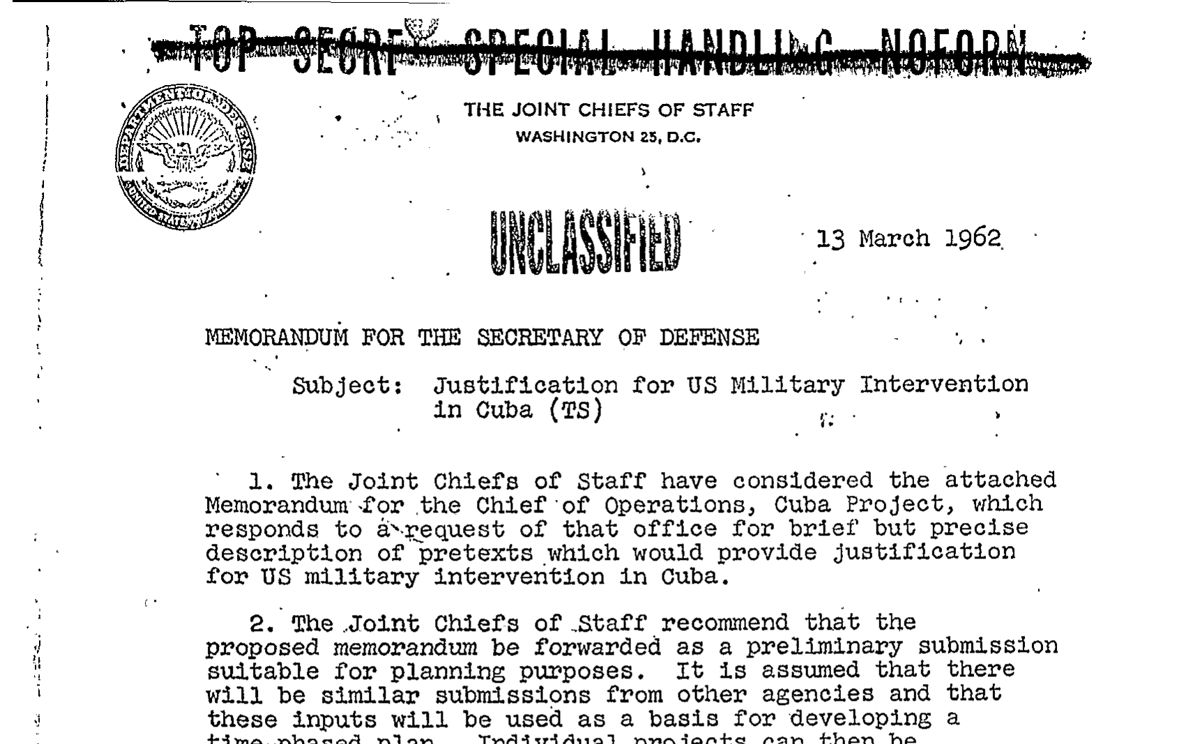
"The government once planned fake attacks to justify a war" sounds like the opening line of a bad thread. In this case, the paperwork exists. It's declassified, it's been online for over twenty years, and you can read it yourself.
What the paperwork doesn't do is prove everything people hang on it. So here's the file, split the usual way.
On the record
The memo is real. On March 13, 1962, the Joint Chiefs of Staff, through their chairman, Gen. Lyman L. Lemnitzer, sent Defense Secretary Robert McNamara a Top Secret memorandum titled "Justification for US Military Intervention in Cuba." It forwarded a list of possible pretexts, written for the chief of operations of the government's anti-Castro "Cuba Project," as a preliminary submission "suitable for planning purposes." The memo (15 pp.), National Security Archive
What it proposed. The annex reads like a menu. It floated a staged attack on the U.S. base at Guantánamo using "friendly Cubans" in Cuban uniforms; blowing up a U.S. ship in Guantánamo Bay and blaming Cuba, a "Remember the Maine" incident; a "Communist Cuban terror campaign in the Miami area, in other Florida cities and even in Washington"; and faking a Cuban fighter shooting down a civilian airliner by swapping in a drone. On one ship scenario it says, plainly, that "casualty lists in US newspapers would cause a helpful wave of national indignation." Memo annex
It was part of a bigger program. The National Security Archive, which posted the memo in 2001, describes the proposals as part of Operation Mongoose, the secret Kennedy-era effort against the Castro government. National Security Archive, Apr. 30, 2001
What happened three days later. On March 16, 1962, President Kennedy met with his Cuba advisers, Gen. Lemnitzer among them, to discuss the guidelines for Operation Mongoose. A handwritten note by State Department official U. Alexis Johnson, printed in the State Department's official history series, records that the President "expressed skepticism that in so far as can now be foreseen circumstances will arise that would justify and make desirable the use of American forces for overt military action," and that "it was clearly understood no decision was expressed or implied approving the use of such forces although contingency planning would proceed." FRUS 1961–1963, Vol. X, Doc. 314
One honest caveat: Johnson's note is about the Mongoose guidelines, not the Northwoods memo by name. It shows Kennedy's skepticism about using U.S. forces at all, three days after the memo was written. It doesn't record a ruling on the pretexts themselves.
None of it was carried out. No staged Guantánamo attack, no faked airliner shootdown, and no U.S. invasion of Cuba followed. The pretexts stayed on paper.
How it came out. On November 18, 1997, the National Archives opened about 1,500 pages of Joint Chiefs of Staff records on Cuba policy, 1962–64, which had been reviewed by the Assassination Records Review Board under the 1992 JFK Records Act. National Archives media advisory The Board's release sheet for the Northwoods record shows it came out with some postponements. ARRB determination, record 202-10002-10104
Still rumor
Here's what the record does not show. None of these claims is established, and we're not presenting them as fact.
- "Kennedy tore it up." It's a great image, but no written rejection of the Northwoods memo by Kennedy or McNamara has been found. Kennedy's skepticism about using U.S. forces is documented. A formal "no" to these specific pretexts isn't.
- "So event X was a false flag." Northwoods gets cited as proof that some later attack was staged. A 1962 proposal that was never carried out is not evidence about any other event. Each claim needs its own documents.
- What's behind the redactions. Parts of the wider Joint Chiefs file were released with postponements. What those passages say is unknown, and guessing isn't evidence either way.
The verdict
Documented The proposals existed, in writing, from the Joint Chiefs to the Secretary of Defense in March 1962.
Documented They were never carried out, and three days later Kennedy was on record as skeptical of using U.S. forces against Cuba.
Unproven That it proves any later attack was staged.
The plan was real. It never left the page. Both halves of that sentence matter, and the second half is the one that usually gets dropped.
Sources
- Joint Chiefs of Staff, "Justification for US Military Intervention in Cuba," memorandum for the Secretary of Defense, 13 March 1962, with annex. PDF via National Security Archive
- National Security Archive, "Pentagon Proposed Pretexts for Cuba Invasion in 1962," Apr. 30, 2001. nsarchive2.gwu.edu
- U.S. Department of State, Foreign Relations of the United States, 1961–1963, Vol. X, Cuba, 1961–1962, Doc. 314, "Guidelines for Operation Mongoose," Mar. 14, 1962, source note quoting U. Alexis Johnson's handwritten note of Mar. 16, 1962. history.state.gov
- National Archives, media advisory on the Nov. 18, 1997 release of JCS Cuba records. archives.gov
- Assassination Records Review Board, final determination for record 202-10002-10104. archives.gov