File No. 03 · Filed November 3, 2026
The CIA cat spy
Real or rumor: the CIA tried to turn a cat into a spy. The memo is real. The best parts of the story aren't in it.
Every few months the internet rediscovers the story: the CIA wired up a cat, sent it to eavesdrop on Soviet officials, and lost it to a taxi on its first day at work. It's a perfect story. That's usually the first warning sign.
Here's the twist. Part of it is on paper. The CIA did look at using trained cats for intelligence work, and a declassified memo says so. The memo just doesn't say most of what the story says.
On the record
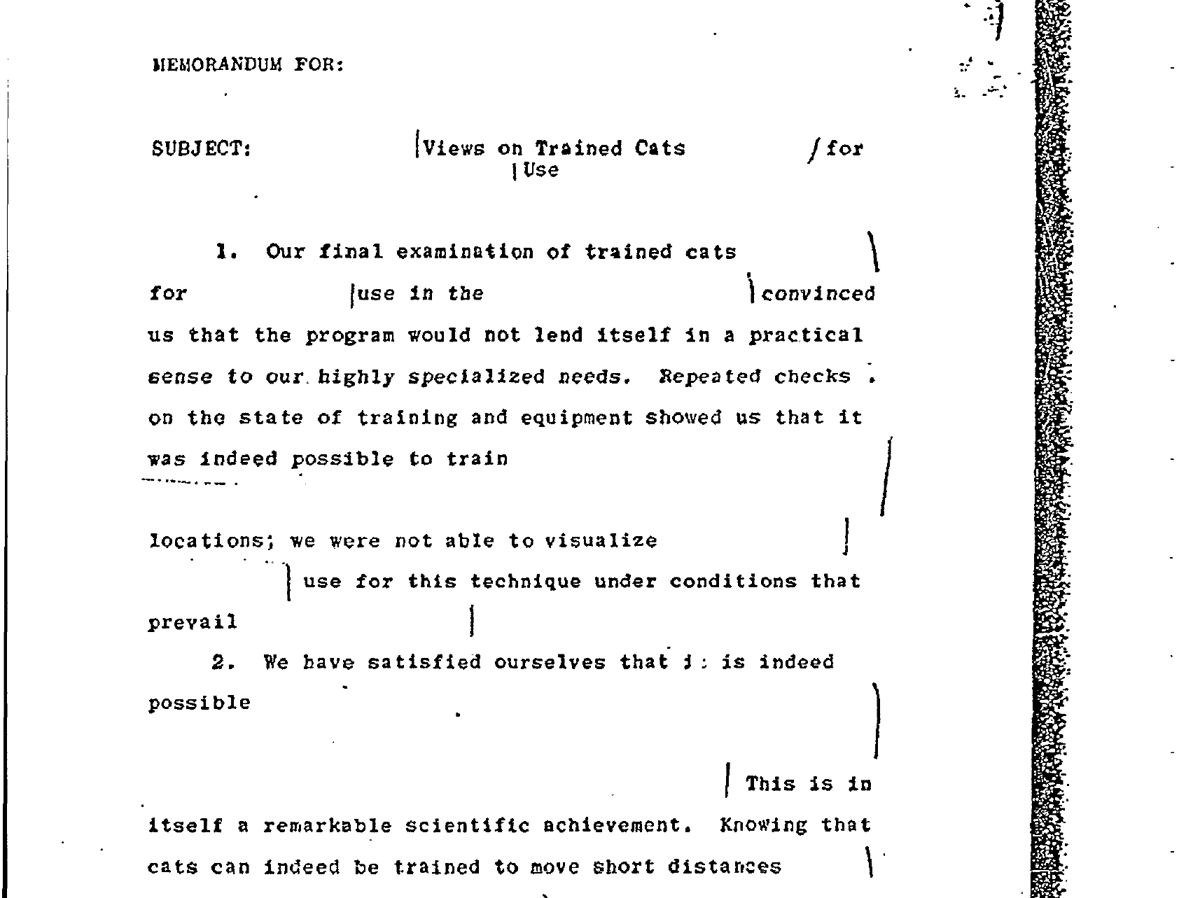
The memo exists. A CIA memorandum dated March 1967, subject line "Views on Trained Cats [deleted] for [deleted] Use," was released in September 1983. Most of it is redacted, including who wrote it, who it was for, and what the cats were being trained to do. The memo (2 pp.), National Security Archive
It confirms there was a program, with training and equipment. The memo opens: "Our final examination of trained cats for [deleted] use in the [deleted] convinced us that the program would not lend itself in a practical sense to our highly specialized needs." It adds that "repeated checks on the state of training and equipment" showed that it "was indeed possible to train" something. The rest of that sentence is blacked out. Memo, p. 1
The cats did learn something. In the second paragraph the writer says that a redacted something "is indeed possible" and that "this is in itself a remarkable scientific achievement." Then: "Knowing that cats can indeed be trained to move short distances," the writer sees "no reason to believe" a cat can't be trained to approach something else. What, exactly, is redacted. Memo, p. 1
And then they dropped it. The memo concludes that "the environmental and security factors in using this technique in a real foreign situation force us to conclude that, for our [deleted] purposes, it would not be practical." It closes by praising the people behind the work, "whose energy and imagination could be models for scientific pioneers." Memo, p. 2
How it came out. The National Security Archive posted the memo as Document 27 in its September 10, 2001 briefing book "Science, Technology and the CIA," edited by Jeffrey T. Richelson. National Security Archive, Electronic Briefing Book No. 54
Still rumor
Here's where the trail goes cold. Everything below may have happened, but none of it is in the released memo, and we're not presenting it as fact.
- The wired cat. The surgery, the batteries, and the tail as an antenna come from former CIA official Victor Marchetti, quoted in John Ranelagh's 1986 book The Agency. The National Security Archive's note on the memo repeats his account. That's a recollection from one person years later, not a document. The memo itself mentions "equipment" and nothing more specific.
- The taxi. The famous ending, where the cat is let out of a van on its first test and promptly run over, is also from Marchetti's account. No released document confirms it. The memo describes a program wound down because it wasn't practical, not one that ended under a cab.
- The name "Acoustic Kitty." It's the name everyone uses, and the National Security Archive's own write-up uses it. It doesn't appear in the released memo, and we haven't seen a primary document that does.
- The price tag. You'll often see a figure in the millions attached to this story. We haven't found that number in any primary document. Treat it as unproven.
- The target. Retellings usually say the cat was sent to listen in on Soviet officials. The memo's redactions hide where and against whom the cats would have been used.
The verdict
Partly documented The CIA did test trained cats for an intelligence purpose, found they could be trained to "move short distances," and dropped the idea in 1967 as not practical. That much is in a declassified memo.
Unproven The surgically wired cat, the taxi ending, the cost, the target, and the name "Acoustic Kitty." All of them come from later accounts, not the released record.
The real story is stranger than you'd expect and duller than you've heard: a two-page memo, mostly blacked out, politely concluding that the cats weren't going to work out. The cat spy program was real. The best parts of the story are still unconfirmed.
Sources
- CIA, Memorandum, Subject: "[deleted] Views on Trained Cats [deleted] for [deleted] Use," March 1967, 2 pp., MORI DocID 21897, released Sept. 1983. PDF via National Security Archive
- National Security Archive, Electronic Briefing Book No. 54, "Science, Technology and the CIA," ed. Jeffrey T. Richelson, Sept. 10, 2001, Document 27 and note. nsarchive2.gwu.edu
- Marchetti's account as quoted in John Ranelagh, The Agency: The Rise and Decline of the CIA (Simon & Schuster, 1986), p. 208, cited in the briefing book above. Secondary source.